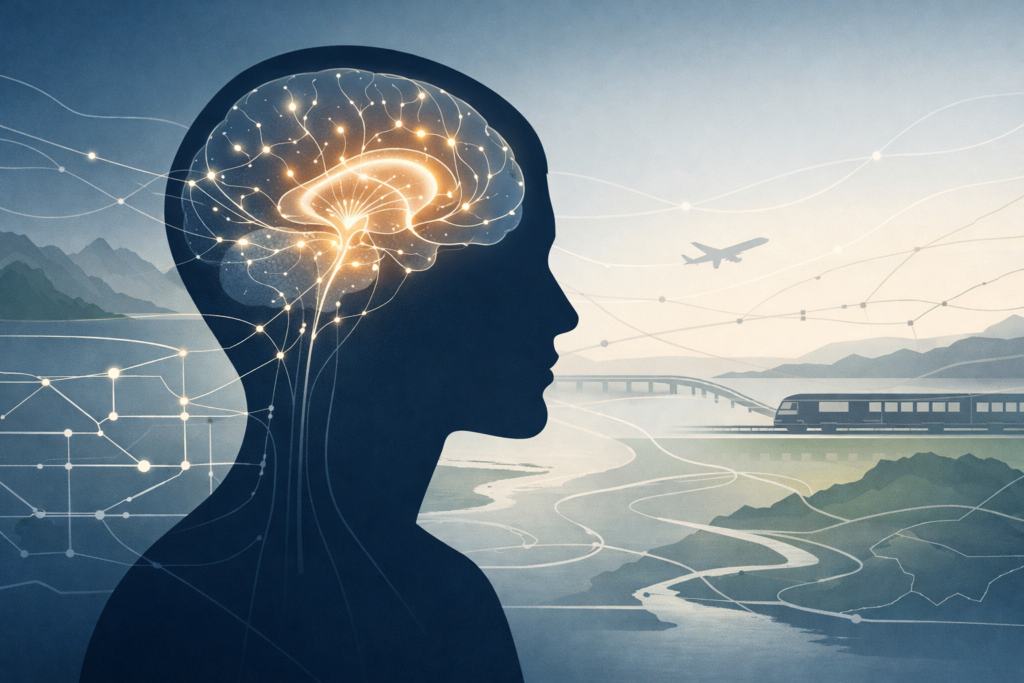
1.0 Introduction: Reframing Travel as a Therapeutic Modality
For decades, the wellness and tourism industries have operated on the intuitive understanding that travel is restorative. Today, neuroscience provides the empirical evidence to transform this intuition into a strategic advantage. Travel is not merely a leisure activity; it is a potent, evidence-based modality for enhancing mental well-being by triggering profound and measurable changes in brain structure and chemistry. Understanding these mechanisms is no longer an academic exercise but a professional necessity for designing experiences that deliver genuine, lasting value.
The purpose of this white paper is to distill the key neuroscientific findings on how travel impacts the brain. By bridging the gap between laboratory research and professional practice, we aim to provide actionable recommendations that enable wellness and tourism professionals to consciously design and promote travel experiences that maximize cognitive and emotional benefits for their clients. We will now explore the fundamental biological mechanisms that power these transformative effects.
2.0 The Core Mechanisms: How Travel Rewires the Brain
To effectively leverage travel as a tool for well-being, it is crucial to understand the fundamental neurobiological mechanisms at play. These processes—involving neurochemicals, neural pathways, and the brain’s inherent adaptability—are the foundation for all the cognitive and emotional benefits that a well-designed journey can produce.
2.2 Dopamine and the Power of Novelty
The feeling of excitement and vividness associated with travel is rooted in the brain’s reward system. Encounters with novel stimuli—new sights, sounds, foods, and social interactions—trigger a release of the neurotransmitter dopamine in key brain regions, including the ventral tegmental area (VTA), locus coeruleus, and the hippocampus. This dopamine spike serves several critical functions. It generates feelings of pleasure and motivation, driving the desire to explore. Crucially, it also acts as a powerful “memory booster.” The release of dopamine enhances the persistence of memories formed during the novel experience, which explains why travel memories are often so vivid and long-lasting. In short, newness makes memories stronger. This mechanism also explains the common “post-travel slump” or “vacation blues.” This is a neurochemical withdrawal of sorts, as the brain recalibrates to a lower baseline of novel stimulation upon returning to a familiar environment.
2.3 Neuroplasticity and Cognitive Enhancement
Neuroplasticity is the brain’s remarkable ability to reorganize itself by forming new neural connections. Travel is a powerful catalyst for this process, stimulating the brain in two distinct ways. First, targeted cognitive tasks associated with navigating an unfamiliar environment directly activate specific brain regions. Active exploration engages the hippocampus (the hub for spatial memory), while planning and problem-solving activate the prefrontal cortex (the center for executive function). Second, the general sensory immersion of a new place—the barrage of unfamiliar sights, sounds, and smells—stimulates multiple lobes of the brain simultaneously. This broad stimulation creates what researchers call a “neural jungle” of new synapses, enriching learning and leading to measurable improvements in cognitive flexibility, creative thinking, and problem-solving skills.
2.4 Stress Reduction and Mental Reset
One of travel’s most sought-after benefits is its ability to provide a mental reset. This effect is grounded in travel’s capacity to disrupt the Default Mode Network (DMN), a network of brain regions that is most active when we are at rest and not focused on the outside world. The DMN is responsible for self-referential thought, and its overactivity is linked to rumination and negative self-focus. By immersing an individual in present-moment tasks—like finding a train station or ordering a meal—travel forces the brain’s attention outward, quieting the DMN. This process is accompanied by physiological changes: levels of the stress hormone cortisol decrease, while mood-regulating neurochemicals like serotonin and endorphins increase. Furthermore, exposure to fractal-rich natural scenes, such as coastlines or forests, is a documented mechanism for reducing stress and can also stimulate Brain-Derived Neurotrophic Factor (BDNF), a protein that supports neuron growth and builds resilience.
These underlying brain mechanisms give rise to the observable and tangible outcomes that individuals experience as a result of travel.
3.0 The Tangible Outcomes: Cognitive, Emotional, and Social Benefits
Understanding the tangible outcomes of travel is crucial for professionals to articulate a clear and compelling value proposition to their clients. The neurobiological shifts discussed previously manifest as concrete improvements in an individual’s cognitive abilities, emotional state, and social life.
3.2 Cognitive Gains
Travel provides a powerful workout for the brain, leading to distinct cognitive improvements.
• Enhanced Memory: The novelty-driven dopamine release during travel strengthens the encoding of episodic memories. This results in the vivid, detailed, and long-lasting recollection of trip-related events.
• Boosted Creativity: Exposure to diverse sensory inputs and different cultural perspectives increases associative and divergent thinking. Studies show that travelers often score higher on creativity tests, as their brains have formed new connections between previously unrelated concepts.
• Improved Cognitive Flexibility: The act of navigating unfamiliar systems, from public transit to social etiquette, trains the brain in mental adaptability. This improves the ability to switch between tasks and approach problems from new angles.
3.3 Emotional and Identity Shifts
Travel frequently produces positive emotional states, which, according to the “broaden-and-build” theory, do more than just feel good. These positive emotions broaden an individual’s attention and help build long-term personal resources such as resilience, new skills, and social networks. Furthermore, unfamiliar settings can temporarily loosen the grip of habitual social roles and the fear of evaluation, allowing for profound personal growth. This situational change can encourage individuals to experiment with new behaviors and, in some cases, can sometimes permanently alter personality traits like openness and conscientiousness, representing one of the most significant potential outcomes of transformative travel.
3.4 Strengthened Social Connections
Travel is a powerful mechanism for strengthening social bonds. Undergoing a novel experience with others creates a shared foundation of unique memories. The subsequent act of storytelling—recounting the journey to friends and family upon return—further solidifies these bonds. This social support system is a key mediator of the mental health benefits associated with leisure travel.
While these benefits are profound, a comprehensive understanding requires acknowledging the potential downsides and limitations of travel.
4.0 A Balanced Perspective: Acknowledging Risks and Boundary Conditions
To maintain professional credibility and design safe, effective, and ethical travel-based wellness programs, it is essential to adopt a balanced perspective. The benefits of travel are not automatic and can be undermined by a range of physiological and psychological stressors.
4.2 Physiological Stressors
The physical act of traveling can impose significant stress on the body and mind, which may temporarily negate its positive effects.
• Jet Lag and Circadian Disruption: The disruption of the body’s internal clock can undermine sleep quality, negatively impacting mood and cognitive performance.
• Post-Flight Cognitive Effects: Aviation medicine has documented transient cognitive disturbances, such as temporary confusion or disorientation, tied to flight conditions like mild hypoxia and dehydration.
• Travel Logistics: The benefits of a trip can be easily overshadowed if the experience is dominated by logistical hassles, financial strain, social stress, or safety concerns.
4.3 Psychological and Social Considerations
Beyond the physical challenges, certain psychological and social factors can limit the positive outcomes of travel.
• Hedonic Adaptation: The initial excitement of a new place can fade as the brain adapts to the novel stimuli. This phenomenon explains why a trip may feel less exciting after the first few days. Sustaining the benefits often requires intentionally seeking out “micro-novelties” throughout the journey.
• Inequity and Access: It is critical to acknowledge that the benefits of travel are a privilege, not a universal resource. Individuals who are unable to travel due to financial, medical, or other constraints do not receive these neurological gains.
Acknowledging these challenges is the first step toward mitigating them, paving the way for practical strategies that maximize the therapeutic potential of travel.
5.0 Evidence-Based Recommendations for Wellness and Tourism Professionals
This section translates neuroscientific theory into actionable strategies. The following evidence-based recommendations are designed to help wellness and tourism professionals structure, advise on, and market travel experiences that are intentionally engineered to maximize positive brain changes and promote sustained well-being.
1. Prioritize Active Exploration over Passive Sightseeing Encourage clients to engage with their destination actively by walking, using local transit, asking for directions, and interacting with local residents. The evidence is clear: Active exploration > passive sightseeing.
◦ Rationale: Active exploration more strongly engages the hippocampus, strengthening the encoding of spatial and episodic memories. This deepens neuroplasticity, making the experience more memorable and impactful than passive observation.
2. Systematically Engineer Novelty Design itineraries that intentionally introduce varied and unpredictable elements. Advise clients to vary their daily routes, try unfamiliar foods, and seek out new neighborhoods or social interactions.
◦ Rationale: Novelty is the primary trigger for the dopaminergic circuits that enhance memory and motivation. Systematically introducing new stimuli maintains this engagement, counteracting hedonic adaptation. Incorporating exposure to fractal-rich natural scenes (e.g., forests, coastlines) can also be used to intentionally quiet the Default Mode Network and maximize stress reduction.
3. Integrate Rest and Reflection Stress the importance of scheduling downtime and recovery days within an itinerary. A packed schedule can increase stress and prevent the brain from processing experiences.
◦ Rationale: Rest is essential for memory consolidation, the process by which the brain transfers short-term experiences into long-term storage. Downtime also allows the body to clear stress hormones like cortisol, preventing DMN overactivity and ensuring the trip remains restorative.
4. Promote Mindful Sleep Hygiene Provide clients with practical guidance on mitigating jet lag. This includes strategies like adjusting sleep schedules before departure, prioritizing light exposure upon arrival to reset circadian rhythms, and practicing good sleep hygiene.
◦ Rationale: Protecting sleep is critical to avoiding the temporary cognitive performance dips and mood disruptions associated with circadian disruption. A well-rested brain is better equipped to learn, adapt, and benefit from hippocampal encoding of new experiences.
5. Facilitate Social Sharing and Storytelling Encourage group travel or design post-trip practices that prompt clients to reflect on and share their experiences with others.
◦ Rationale: Social processing and storytelling help solidify positive memories and integrate the lessons from a trip. This act of sharing strengthens the associated well-being gains and reinforces the social bonds that are crucial for long-term mental health.
By implementing these strategies, professionals can elevate travel from a simple vacation to a truly transformative wellness experience.
6.0 Conclusion: The Future of Evidence-Based Therapeutic Travel
This white paper has synthesized a compelling body of evidence demonstrating that travel, when designed with neuroscientific principles in mind, is a powerful and legitimate tool for enhancing mental well-being. By driving neuroplasticity, activating reward systems, and providing a reset from cognitive rumination, travel can produce lasting improvements in memory, creativity, and emotional resilience.
The key takeaway is that professionals in the wellness and tourism industries are uniquely positioned to act as architects of these transformative experiences. By moving beyond intuition and leveraging this evidence, you can create more impactful, valuable, and scientifically-grounded programs for your clients, clearly articulating the “why” behind the magic of travel.
The field of therapeutic travel is still emerging, and there is a clear need for continued research. Future work, including more causal neuroimaging studies in real-world settings and investigations into the specific needs of different populations, will further refine our understanding. However, the existing science provides a robust foundation upon which to build a new generation of travel experiences—ones that are intentionally designed to help the traveler’s brain, and the traveler, return home changed for the better.