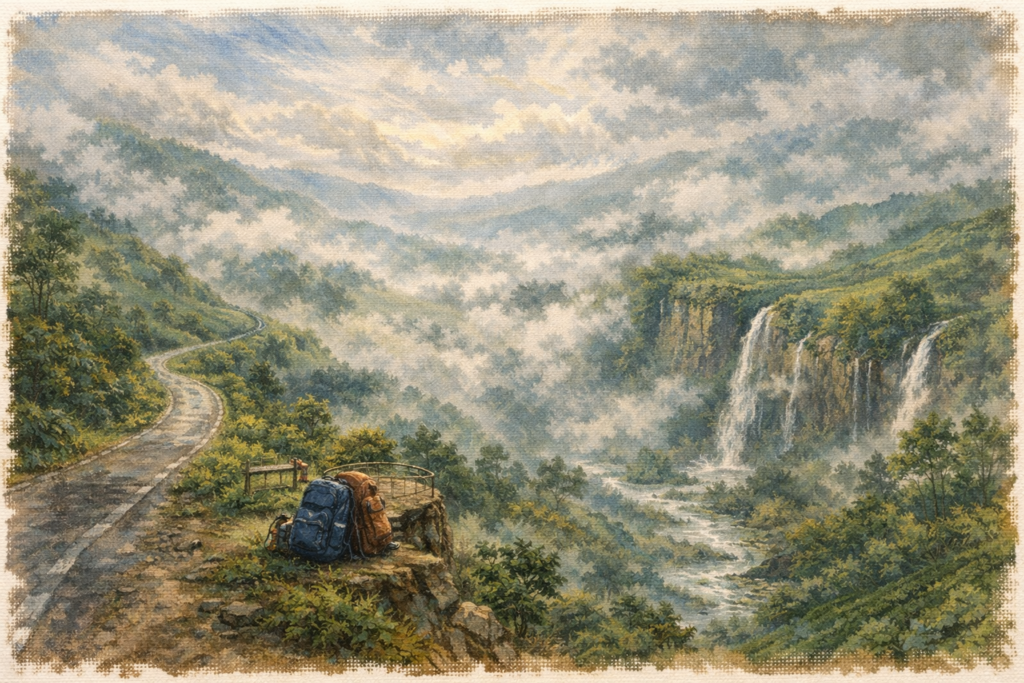
It was 2017, just a few months after I had joined college, when our professors announced a trip to Meghalaya. For most of us, it was our first time travelling so far with friends, so the excitement was on another level. I still remember standing on the platform in Kolkata with my backpack, watching the train slowly arrive, thinking about the adventure that was waiting for us.
The journey from Kolkata to NJP was filled with jokes, snacks being passed around, loud songs, and that pure college energy. By the time we reached NJP the next morning, we were tired but fully charged for the next step of our expedition. From there, we hopped into a shared cab towards Guwahati, squeezing in with all our luggage. I somehow managed to grab the window seat, and little did I know that this window would show me some of the most beautiful views of my life.
As we crossed into Meghalaya, everything started to look different — the hills rose higher, forests became denser, and clouds drifted so low that it felt like we could reach out and touch them. Every few minutes, the sky would burst into a soft drizzle, and the sunlight would slip through the clouds like golden ribbons. Streams of crystal-clear water rushed beside the road, and the entire landscape looked washed, fresh, and alive. That was the moment I fell in love with Meghalaya.
Our first major stop was Cherrapunji, and instantly the rain welcomed us like an old friend. Here, waterfalls were everywhere — some roaring loudly like Nohkalikai, some falling gently in layers like Seven Sisters, and some hidden deep inside forests like Wei Sawdong. Every waterfall had its own personality, its own story. But what fascinated me even more were the limestone caves. Walking inside Mawsmai Cave, bending, crawling, feeling the cool air and listening to the droplets echo inside the chambers — it felt like entering a natural museum built over thousands of years.
One of the most surreal experiences was visiting the Double-Decker Living Root Bridge in Nongriat. The trek was long, with countless stairs, but reaching that natural bridge woven from living roots felt magical. Standing on it, surrounded by dense greenery and streams flowing beneath, I understood why people say Meghalaya is a place where nature and humans live in complete harmony.
The trip became even more special when we visited Mawlynnong, famously known as the cleanest village in Asia. The moment we entered, I was shocked by how beautiful and spotless it was. Bamboo pathways, colourful flowers everywhere, and villagers who kept every corner clean with so much pride — it taught me that cleanliness isn’t a rule here, it’s a lifestyle.
But the place that completely stole my heart was Dawki. When I first saw the river, I honestly couldn’t believe it was real. The water was so clear that I could see every stone lying at the bottom, and boats looked like they were floating in the air. Sitting near the river, dipping my hands into the icy-cold water, watching sunlight dance on the surface — it felt peaceful in a way I had never felt before.
Our journey ended in Shillong, a city full of music, cafés, pine trees, and young energy. The markets were lively, the food was delicious, and the weather made everything feel magical. Shillong felt like the perfect ending to our Meghalaya story — gentle, vibrant, and full of charm.
When we finally returned from the trip, I realised how deeply Meghalaya had touched me. It wasn’t just about visiting famous spots. It was the rain that came without warning, the waterfalls that made the air smell fresh, the caves that whispered old stories, and the calm rivers that felt like mirrors. It was about being with friends, discovering nature, and feeling alive in every moment.
Even today, whenever I think of Meghalaya, I remember that window seat, the rolling hills, the floating boats, the clean villages, and the endless rain. That journey wasn’t just a college excursion — it was the beginning of my love for travel and storytelling.